

The Bookshelves
A curated collection of books that have informed, challenged, and shaped the way we think about outdoor education, facilitation, experiential learning, and human development. Not an exhaustive list — a personal one. These are the books on the shelf, the ones that get recommended and the ones that have left a mark.
Click on a category below to explore our Bookshelf

Outdoor Education

Best For:Teachers, school coordinators, and programme designers looking to connect outdoor learning directly to curriculum objectives across all subjects.
A comprehensive and practical text that bridges the gap between theory and real-world outdoor teaching. The authors make a compelling case for taking learning beyond the classroom walls — not as an add-on, but as an integrated part of how children engage with every subject. Grounded in research, accessible in tone, and full of usable guidance for those designing curriculum-linked outdoor experiences.
Best For: Early years practitioners, primary school teachers, and anyone working with children who wants a solid grounding in why and how outdoor learning works at this stage of development.
An edited volume covering the full breadth of outdoor learning for young children — from early years through to age eleven. Contributors bring perspectives from forest school, nature play, environmental education, and formal curriculum, making this one of the most comprehensive resources available for educators working with younger age groups. The second edition reflects significant developments in the field since the first publication.


Best For: Outdoor instructors, programme leaders, and those studying or working in adventure education at any level — from new practitioners to experienced professionals.
One of the definitive texts in adventure education. Priest and Gass cover the theory and practice of leading adventure programmes — from sequencing and facilitation to safety, ethics, and programme design. The third edition updates a classic with current research and thinking. If you're only going to own one adventure education textbook, this is a strong candidate.
Best For: Physical education teachers, outdoor instructors, camp leaders, and anyone who needs a reliable, ready-to-use planning resource for outdoor programmes.
A practical, field-tested resource containing 21 units and 140 lesson plans covering a wide range of outdoor topics. Designed to be flexible and adaptable rather than prescriptive — the kind of resource that saves hours of planning time while still producing quality, purposeful outdoor sessions. Less about philosophy, more about getting things done well.


Best For: Students of outdoor and adventure education, experienced practitioners looking to deepen their theoretical understanding, and anyone interested in the critical development of the field.
A wide-ranging edited collection covering the theory, practice, and critical perspectives of adventure education. Contributors bring diverse viewpoints to questions of purpose, pedagogy, safety, and the future of the field. A useful text for those who want to engage with the bigger debates in adventure education, not just the practical how-to.
Best For: Students, academics, and reflective practitioners who want a solid grounding in the theory and intellectual heritage of experiential education.
An invaluable reference covering the key thinkers, theories, and contributions that have shaped experiential education as a field. From Dewey to Kolb to contemporary voices, this sourcebook maps the intellectual history of the discipline in an accessible and well-organised way. Essential reading for anyone who wants to understand where experiential education comes from and where it's heading.


Best For: Programme managers, outdoor educators, and anyone with operational or administrative responsibility for outdoor adventure programmes.
The textbook companion to Viristar's world-leading risk management course, also stands alone in it's own right. Covers human factors, emergency planning, equipment management, legal considerations, and the systems thinking behind safe outdoor programme delivery. Rigorous and practical in equal measure — written by someone who has spent decades consulting on outdoor safety.
Best For: Primary school teachers, teaching assistants, and school leaders looking to develop a more coherent approach to learning in and outside the classroom.
A thoughtful and accessible exploration of how indoor and outdoor learning environments can complement each other in primary education. Thomas makes the case for a fluid, integrated approach that uses the outdoors not as a special event but as a natural extension of everyday learning. Particularly useful for class teachers who want practical ideas without heavy theory.


Best For: Early years and primary educators, school leaders, and anyone designing outdoor learning spaces who wants to think beyond the obvious and make better use of everyday environments.
A practical and thought-provoking guide to rethinking the spaces where children learn outdoors. Murdoch challenges the assumption that outdoor learning requires specialist environments — arguing instead that everyday spaces, used intentionally, can be just as powerful. Full of ideas for making the most of what you already have, wherever you are.
Best For: Physical education teachers, outdoor instructors, camp leaders, and anyone who needs a reliable, ready-to-use planning resource for outdoor programmes
A practical, field-tested resource containing 21 units and 140 lesson plans covering a wide range of outdoor topics. Designed to be flexible and adaptable rather than prescriptive — the kind of resource that saves hours of planning time while still producing quality, purposeful outdoor sessions. Less about philosophy, more about getting things done well.
Facilitation & Group Work

Best For: Facilitators, coaches, team leaders, and anyone who regularly needs to help groups think together, navigate disagreement, and arrive at decisions that actually stick.
A landmark text on the art and science of facilitation — specifically focused on helping groups make genuine decisions together rather than rubber-stamping whatever the loudest voice suggests. Kaner's groan zone model alone is worth the price of the book. Deeply practical, beautifully structured, and applicable far beyond the corporate meeting room.
Best For: Facilitators, outdoor educators, coaches, and team development practitioners who want a deeper, more varied toolkit for processing experience.
The go-to resource for facilitators who want to move beyond surface-level debrief. Packed with structured activities specifically designed to help groups extract meaning from their experiences — not just talk about what happened, but understand what it means and what to do with it.
_Page_3.jpg)

Best For: Outdoor educators, corporate facilitators, youth workers, and team leaders looking for a reliable bank of group activities with clear facilitation guidance.
A comprehensive collection of cooperative games, activities, and challenges designed to build genuine teamwork. Cain and Jolliff understand that the activity is only half the equation — the other half is how you facilitate the learning that comes from it. Well-organised, extensively field-tested, and still one of the most practical resources available for group-based programming.
Best For: Outdoor instructors and facilitators who want a quick, visual field reference for group activities.
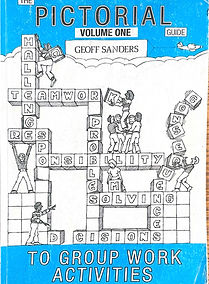
An illustrated collection of group work activities in Sanders' signature visual format — each activity presented clearly enough to brief and run without lengthy written instructions. Volume One in a two-part series.
_Page_1.jpg)
_Page_2_edited.png)
Best For: Facilitators and outdoor instructors looking to expand their activity bank — a companion volume with a fresh set of clearly illustrated group challenges.
The second volume in Sanders' illustrated series, offering a further range of group work activities in the same practical, visual format. Each activity is presented in a way that makes it easy to brief quickly and run without lengthy instructions, whether in a classroom, training room, or the field.
Best For: Outdoor instructors, ropes course facilitators, and adventure education practitioners who want a definitive reference for challenge course and initiative programming.
A classic in the adventure education canon. Rohnke presents a wide range of ropes course, initiative, and adventure activities with the hands-on, no-nonsense approach that made the original a staple of the field. Owning this one signals you know your history.

_Page_4.jpg)
Best For: Outdoor instructors, adventure educators, and facilitators looking for a rich, field-tested activity bank with clear leadership guidance.
A classic collection of adventure games, initiative problems, and trust activities — written with the wit and irreverence that made Rohnke a beloved figure in the adventure education world. Quicksilver covers the full range from warm-up games to complex team challenges, with guidance on leadership and facilitation woven throughout.
Best For: Camp directors, HR teams, team leaders, and outdoor programme managers who need a reliable, energising activity bank for staff training sessions.
More than fifty activities specifically designed for staff training and development — covering communication, teamwork, leadership, and problem solving. Active, engaging, and built to make staff training sessions memorable rather than endured. A practical resource for anyone who regularly runs inductions, CPD sessions, or team development days.
_Page_5.jpg)

Best For: Facilitators, coaches, and outdoor educators at any stage of their practice who are ready to look inward as well as outward.
Not your typical facilitation book. Lahnthaler blends powerful stories, sharp insights, and reflective prompts to challenge facilitators to move beyond polished techniques — into the messy, emotional, and often uncomfortable realities of working with people. Asks more than it answers, and that is precisely the point.
Best For: Outdoor educators, facilitators, programme leaders, and anyone who has ever found themselves managing an unexpected crisis and wondered how to lead well through it.
A companion to Facilitating Reflections, this book turns its focus to crisis — what it means to navigate genuinely difficult situations with clarity, integrity, and care. Lahnthaler draws on The Crisis Compass framework to help practitioners move beyond reactive responses toward thoughtful, values-led leadership when things go wrong.


Best For: Facilitators, educators, coaches, team leaders, and anyone who runs workshops, meetings, or development sessions and wants a practical, portable toolkit they can reach for on the day.
Pip Decks produce a series of card-based toolkits — each one a standalone deck covering a different aspect of facilitation and creative work. The range includes Idea Tactics (breaking through creative block and generating better ideas), Team Tactics (designing and improving how teams work together), Workshop Tactics (running better meetings and workshops — over 50 techniques in one deck), Storyteller Tactics (crafting and delivering compelling presentations and pitches), and even a UX Tactics deck for those working in product and design. Each card is a self-contained technique with clear instructions on what it does, when to use it, and how to run it. No prior training required — just pick a card and go.
Best For: Facilitators, team leaders, coaches, and HR professionals who want to build trust and authentic connection in teams — particularly useful at the start of a new team, following conflict, or during development programmes.
A research-backed card toolkit designed to build genuine connection and psychological safety in teams and groups. Developed by We! Engage, the toolkit uses structured conversation prompts and activities that help people move from polite surface-level interaction to the kind of honest, open engagement that makes teams actually work. Used by facilitators and leaders worldwide.

Experiential Learning

Best For: Learning designers, outdoor educators, coaches, and facilitators who want to work more intentionally with experiential learning methodology.
A wide-ranging practical toolkit from one of the leading voices in experiential learning design. Beard draws on decades of research and practice to offer frameworks, tools, and approaches for designing learning experiences that genuinely change people. Less about individual activities and more about the architecture of meaningful learning — how to sequence, structure, and facilitate experiences that land.
Best For: Experienced practitioners, learning designers, and academics who want a deep, research-grounded framework for designing experiential programmes.
Beard's most comprehensive work on the theory and practice of learning design — bringing together his research into sensation, perception, emotion, and meaning-making to offer a genuinely holistic framework for creating powerful learning experiences. One of the most intellectually rigorous books in the field, and all the more useful for it. A book to sit with rather than skim.


Best For: Educators, curriculum designers, and anyone responsible for programme design who wants a rigorous theoretical foundation for outcomes-based learning.
The definitive guide to constructive alignment — Biggs's influential framework for designing learning that genuinely achieves its intended outcomes. Though focused on higher education, the principles apply across all learning contexts. The SOLO taxonomy and constructive alignment model have shaped curriculum design internationally. Dense but repays careful reading.
Workplace Learning

Best For: L&D professionals, managers, HR leads, and organisational leaders who want to understand how their people actually learn — and how to make more of it.
A practical and accessible exploration of how most workplace learning actually happens — not through formal training, but through conversations, observations, mistakes, and the daily flow of work. Matthews makes a compelling case for recognising, supporting, and designing for informal learning rather than relying entirely on courses and programmes. A mindset shift as much as a methodology.
Best For: L&D practitioners, managers, performance consultants, and anyone who finds themselves repeatedly solving the same problems without lasting results.
Matthews argues that performance problems are rarely what they appear to be on the surface — and that jumping to training as a solution often misses the root cause entirely. This book is a field guide for diagnosing what's actually driving poor performance and taking targeted, proportionate action. Practical, clear, and genuinely changes how you look at performance gaps.

Best For: Anyone who designs, delivers, or commissions training and wants it to actually make a difference — not just deliver a positive post-course evaluation.
The third and arguably most important book in Matthews' trilogy — addressing the persistent gap between what people learn in training and what they actually do back in the workplace. Full of practical ideas for wrapping learning events in before-and-after support that makes the difference between knowledge acquired and behaviour changed.
Internal Intelligence (EQ, NLP & Mindsets)

Best For: Coaches, facilitators, trainers, and HR professionals who want ready-to-use EQ activities for workshops, team sessions, or individual coaching.
Fifty structured activities for building emotional intelligence in individuals and groups — each with clear instructions, debrief questions, and participant materials. Practical and immediately usable, with activities organised around the core EQ competencies: self-awareness, empathy, social skills, and more. The debrief questions alone are worth having.
Best For: Outdoor educators, school counsellors, coaches, and facilitators working with children and young adults who want to develop EQ through experiential methods.
Over 150 time-tested experiential activities designed to enhance emotional intelligence in children and young adults. Goldsmith unites the joy of adventure-based games with training in emotional awareness, behavioural control, and relationship skills — grounding everything in experiential counselling methodology. Well-organised, flexible, and built for real-world use with groups of varying ages and needs.

Best For: Coaches, educators, and leaders who want the foundational text on EQ — and the research behind why emotional intelligence matters more than most traditional measures of ability.
The book that brought EQ into mainstream conversation. Goleman draws on neuroscience and psychology to make the case that emotional intelligence — self-awareness, empathy, impulse control, and social skill — is a better predictor of life success than conventional IQ. A foundational text that shaped how the field thinks about human potential.
Best For: Anyone coming to EQ for the first time, or practitioners looking for a concise reference before going deeper with Goleman or the 6seconds model.
A compact, accessible introduction to the principles of emotional intelligence, covering what it is, why it matters, and how to develop it. Part of the Introducing series, designed to translate complex ideas into real-life application without losing the substance.


Best For: Facilitators and coaches looking to understand the NLP toolkit before applying it in practice — a clear entry point before tackling Bandler and Grinder directly.
A clear and concise overview of the core ideas behind NLP — how language shapes thought, how patterns of behaviour are formed, and how they can be changed. Part of the same Introducing series, grounded in practical application rather than theory for its own sake.
Best For: Coaches and leaders working in organisational settings who want NLP tools translated into the everyday language of professional life.
A focused application of neurolinguistic programming principles in workplace contexts. Lowther translates NLP tools — reframing, rapport-building, state management, and pattern interruption — into practical techniques for leadership, communication, and managing change.


Best For: Practitioners who want the source perspective — Bandler's own voice — alongside the theoretical frameworks they may have encountered elsewhere.
Co-authored by NLP's co-creator, this is among the most direct and energetic introductions to the field. Rather than a textbook approach, it reads like a coaching session — practical, challenging, and focused on transformation rather than explanation.
Best For: Those who want to understand the theoretical foundations of NLP — why it works when it does, and where the model originated.
The original text that gave NLP its academic foundations. Bandler and Grinder analysed the language patterns of master therapists — including Virginia Satir, whose introduction opens this volume — to identify what made them effective. Dense in places, but essential reading for serious practitioners.


Best For: Practitioners with some NLP grounding who want to understand the role of emotion, non-verbal communication, and incongruence in therapeutic and facilitated change.
The second volume of the original series that laid the academic groundwork for NLP. This volume shifts focus from language patterns to communication and change more broadly — more technical than their later work, but valuable for understanding where the model came from.
Best For: Anyone working in education, coaching, leadership, or parenting — one of the most transferable and immediately applicable books on human development available.
Dweck's landmark work on the difference between fixed and growth mindsets, and why that distinction shapes achievement, resilience, and the capacity to learn. One of the most cited books in modern education and coaching, with good reason — the ideas are simple to grasp and profound in their implications.

Forest School
Best For: Forest School practitioners, outdoor educators, and anyone working with children in natural environments who wants both practical guidance and a deeper theoretical foundation.
A thorough and thoughtful guide to Forest School practice and the broader philosophy of nature pedagogy that underpins it. Cree and Robb go beyond the practical to explore why connecting children with nature matters — developmentally, emotionally, and ecologically. Grounded in both research and years of direct experience in the field.
Best For: Forest School leaders, parents, teachers, and anyone who wants practical, engaging outdoor activities to share with children.
A hands-on, activity-rich guide to Forest School skills and outdoor play — accessible and warm in tone, with clear guidance for building fires, shelters, dens, and a sense of adventure. Less theoretical than some Forest School texts, but genuinely inspiring and full of ideas that children will love. A good book to have on the shelf alongside more academic resources.


Best For: Forest School practitioners, parents, after-school clubs, and anyone looking to bring more outdoor play and creativity into children's lives.
Exactly what it sounds like — a joyful, practical collection of woodland games, crafts, and activities rooted in the Forest School tradition. Accessible enough for parents and community leaders as well as practitioners, and infectious in its enthusiasm for getting children outside and making things. A reminder that outdoor education doesn't always need to be serious.